
QUESTIONS & ANSWERS:
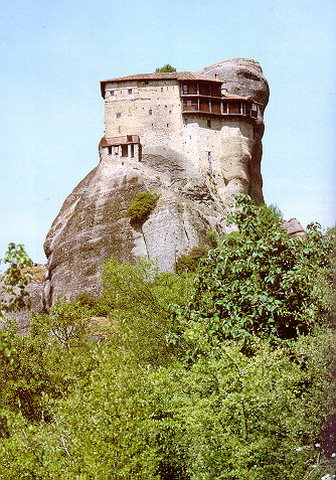 1) What is the peculiarity of the rock on the top of which the St. Nicholas Anapafsas Monastery is built and what did this peculiarity affect?
 1) What is the peculiarity of the rock on the top of which the St. Nicholas Anapafsas Monastery is built and what did this peculiarity affect?
The rock, on the top of which the monastery is built, has a very limited surface. This fact affected the construction of the buildings of the monastery that could not extend. Therefore the only solution was to erect buildings in height. The monastery has three floors.
2) What is the historical evolution of the St. Nicholas Anapafsas Monastery?
As to the construction date of the monastery there is neither enough evidence nor written sources. It is believed that the first hermits reached the rock during the early part of the 14th century. This dating is based on the remains of the frescoes (painted in the 14th century) of the St. Antony chapel that is situated on the first floor. The monastery was totally renovated in 1510 and the present katholikon the St. Nicholas church- was built from the beginning by St. Dionysius, the Metropolitan of Larisa and priest-monk Nikanoras, the exarch of Stagoi. From the beginning of 1900 the monastery was abandoned and the desolation began. In the sixties the St. Nicholas monastery was restored and renovated by the Archeological Service of the region. Up to 1982 Father Palamas lived there. When he was forced to leave, the monastery was closed for 15 years. It was open by the priests of Kalampaka only in the summer for the tourists. It started to operate again in 1997.
3) Why was the monastery named Anapafsas?
The origin of the name is not ascertained. Anapafsas may be the surname of a founder of the monastery, of priest-monk Nikanoras or of an earlier founder that lived in the 14th century. But there is also a second theory that prevails. According to this theory the name is owed to the location of the monastery because it offers physical and mental rest, refreshment and calm to everybody: to monks, visitors and humble pilgrims of the monastery.
4) How could someone have access to the peak of the rock during the first years of the existence of the monastery? How was the monastery reached the following years and nowadays?
Just like in the other monasteries, ascent to the St. Nicholas rock was made by ladders and the traditional net. The ascent took a long time because of the height of the rock. So, later they built steps carved in the rock. Today objects are hoisted electrically.
5) How many monks lived in the St. Nicholas Anapafsas Monastery in the old days and how many nowadays?
We have no information about the number of monks that lived in the St. Nicholas Anapafsas Monastery in the old days. Nowadays a monk, abbot archimandrite Polykarpos Venetis, lives here.
6) What are the architectural features of the katholikon of the St. Nicholas Anapafsas Monastery?
The katholikon of the monastery (the St. Nicholas church) spreads all over the second floor. It consists of a small nave that has an irregular shape (almost square), adapted to the shape of the rock. It has a little dome in the centre of the roof that is dark and with no windows as the third floor had to be built on the top of it. In front of the nave there is a narthex that is more spacious than the nave.
7) Who decorated with frescoes the katholikon of the monastery and when? Could you mention some characteristic frescoes?
The katholikon was decorated in 1527 by the famous painter from Crete, Theophanes Strelitzas, who probably was a monk those days. At the lower part of his paintings he used to write his monogram Ch.M. The decoration of the katholikon of the St. Nicholas Anapafsas Monastery is the first work bearing the signature of this great artist who was the leader of the Cretan School. The frescoes have all the special features of his unique art: delicacy, vividness, bright colours. The depictions of Christ’s humiliation, the Virgin praying, Jonah in the mouth of the Fish, the Liturgy of Angels and the Day of Judgement are distinguished. It seems that it was the first time that Theophanes tried and made such a great work. So his frescoes are beyond all expectations and even the most demanding art-lover is amazed. As it has already been mentioned they are the only frescoes of Theophanes that bear his signature while his paintings in other monasteries and especially on Mount Athos are not signed.
8) Apart from the katholikon on the second floor, what other buildings are there in the first and the third floor of the monastery?
On the first floor there is the St. Antony chapel that is very little but also very important because there we can see a few remains of old frescoes dated from the 14th century. There is also a crypt where in the old times the monastery codices and relics were kept.
On the third floor, we can find the old refectory decorated with frescoes. Today it has been renovated and it is used as the formal reception hall. There is also the ossuary and the St. John the Baptist chapel that has also been renovated.
9) Are there any manuscripts in the monastery?
No, there are not because the monastery was closed for a lot of years and the manuscripts have been transferred to the St. Stephen Monastery. There they were preserved and they are in a very good condition. They were recorded by Dimitris Sofianos. I believe that they will be transferred again to the St. Nicholas Monastery soon.
10) In all the monasteries there is the “talanto”. Could you tell us about the importance of calling the monks with it?
The “talanto” refers to the Old Testament. Noah before the Flood had a piece of wood and he knocked at it so that the animals could go to the ark in order to survive. Today we knock at this piece of wood (the “talanto”) so that the monks of the “new ark”, namely the monks of the monastery could go to attend the religious service, praising God and asking for salvation.
11) Finally, what’s the name of this room?
This room is called “archontariki” (=guest quarters). It is a reception hall, something like the present living room. It is important because here they welcome people like “archontes” (=princes). This is the origin of the “archontariki”. In the old days here the monks used to wash the visitors’ feet.